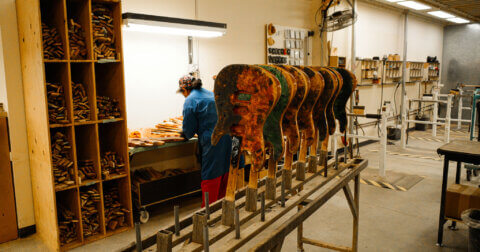
Some guitar stories begin in a music shop. Others begin somewhere far more primordial. Think the energetic flow of a factory floor, where raw timber becomes an heirloom instrument. Earlier this year, following NAMM 2026 in Anaheim, the Swee Lee team made a pilgrimage that every guitar lover dreams of: A behind-the-scenes visit to the Taylor Guitars factory in El Cajon, California.
What we witnessed was nothing short of extraordinary.
We walked the same floors where thousands of Taylor acoustics take shape every year, watched craftsmen at every stage of the guitar-building process, and stood alongside Andy Powers, Taylor’s Chief Guitar Designer and CEO, as he personally hand-selected four premium tonewood sets destined for four bespoke Swee Lee Taylor Custom guitars.
Shop Taylor Guitars at Swee Lee
These amazing acoustics are now available, and they represent a once-in-a-generation opportunity to own something truly special. This is the story of that visit, those four special guitars, and what it all means against the backdrop of Taylor’s most significant product launches in years.
Inside El Cajon: The Heartbeat of American Acoustic Guitar-Making
Taylor Guitars has called El Cajon, California, home since the very beginning. Founded in 1974 by Bob Taylor and Kurt Listug, the company has grown from a small workshop into one of the world’s most respected acoustic guitar makers — all while remaining rooted in the same Southern California community. Today, the factory is a sprawling, meticulously organised operation, and the moment you step inside, you understand why Taylor guitars feel the way they do.
The visit came directly after NAMM, which meant we arrived still buzzing from Taylor’s landmark dual announcement: the Next Generation lineup and the expanded Gold Label Collection. Seeing those announcements come to life on the factory floor gave the whole trip an almost unreal quality.
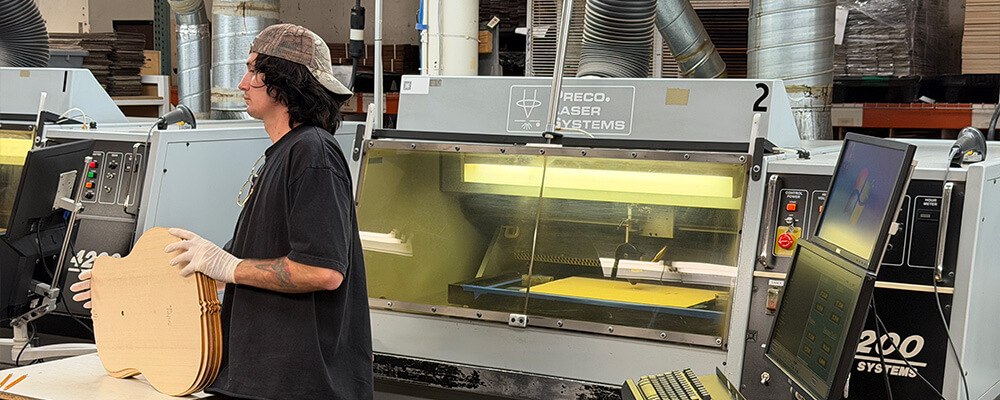
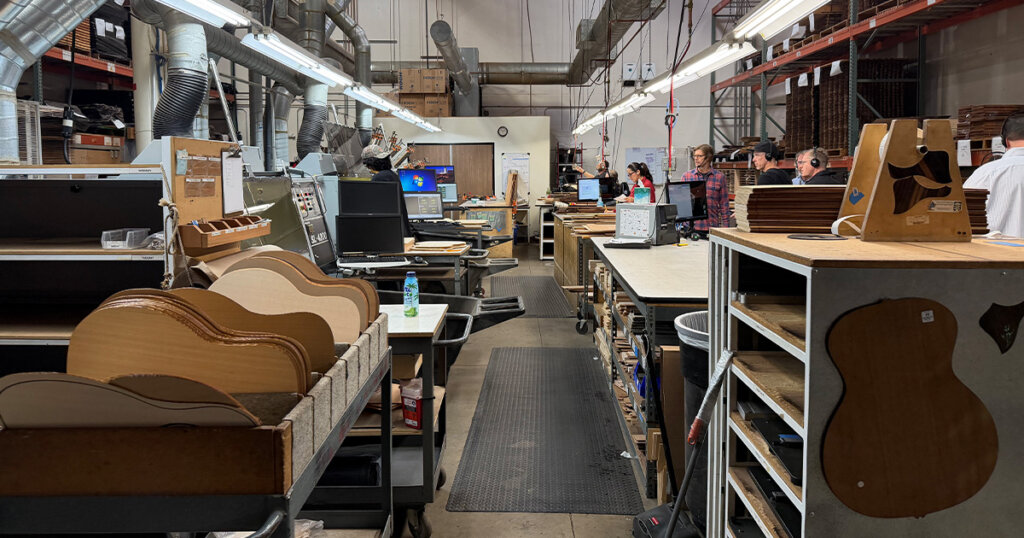
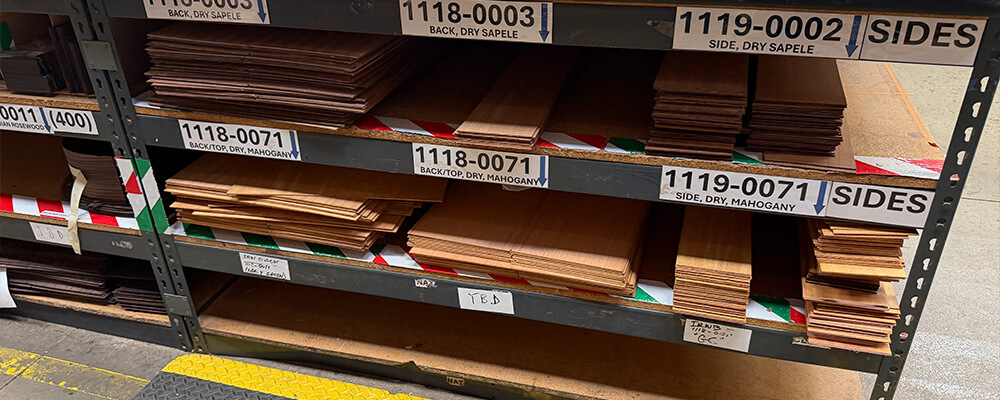
What strikes you first is the scale, and then the order within that scale. Shelving systems reaching ceiling height hold countless pre-cut tonewoods — each tagged, catalogued and waiting for their moment. On one side of the building, stacks of rosewood in deep, chocolatey swirls. On another, high-grade solid wood tops in every species. Every piece is destined for a specific guitar, tracked and accounted for with the precision you’d expect from a company known for their impeccable quality.
We walked through the wood preparation area, where raw timber is received, graded, dried and cut. Taylor operates some of the most advanced CNC and laser machinery in the industry, shaping guitar tops with extraordinary accuracy. But what’s remarkable is how seamlessly that technology sits alongside traditional woodworking skills — because at Taylor, both are essential for creating the best acoustic guitars possible.
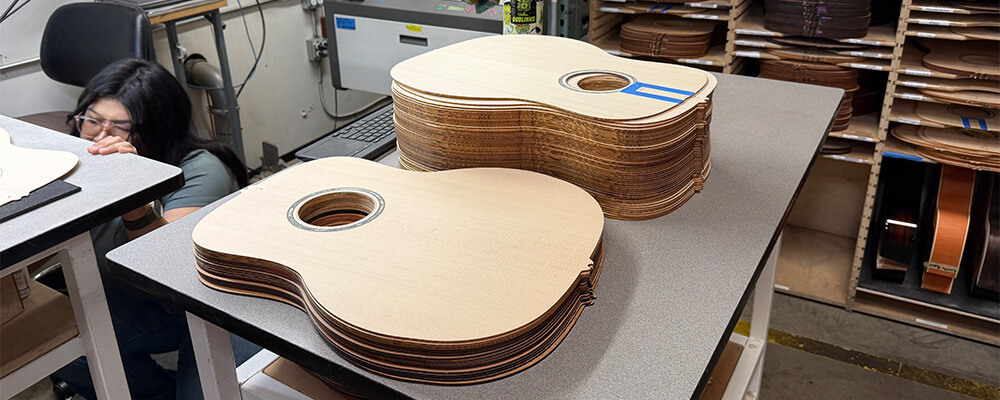
We watched guitar bodies being assembled in real time — sides bent and coaxed into form, braces carefully fitted and voiced, tops married to backs with a craft that felt almost meditative. Every station along the production line had its own rhythm, its own particular set of skills. Workers who have spent years perfecting a single aspect of the build process, whether that’s binding, fret work, or the final setup, bring an expertise to their role that no machine can replicate.
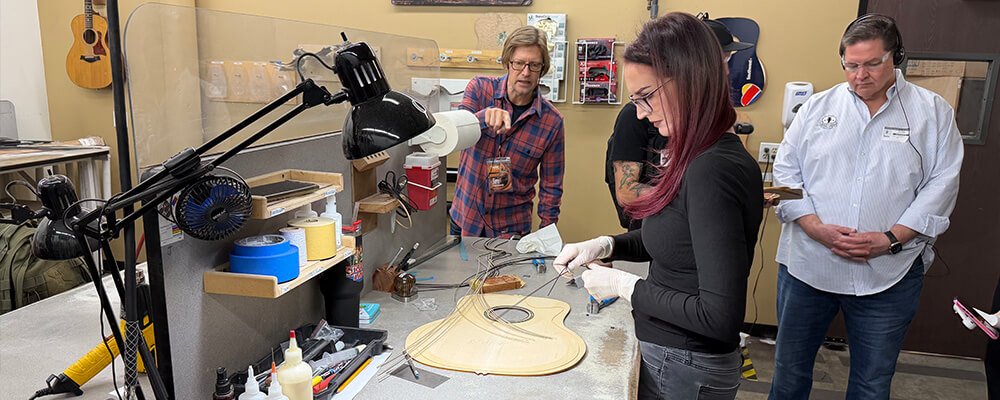
The neck-building area was particularly fascinating. Taylor’s famed bolt-on neck joint was on full display. The jig wall we photographed, with its array of neck templates for every model Taylor makes, is a testament to the sheer breadth of the Taylor catalogue.
From Wood to Instrument: A Guitar’s Journey Through the Factory
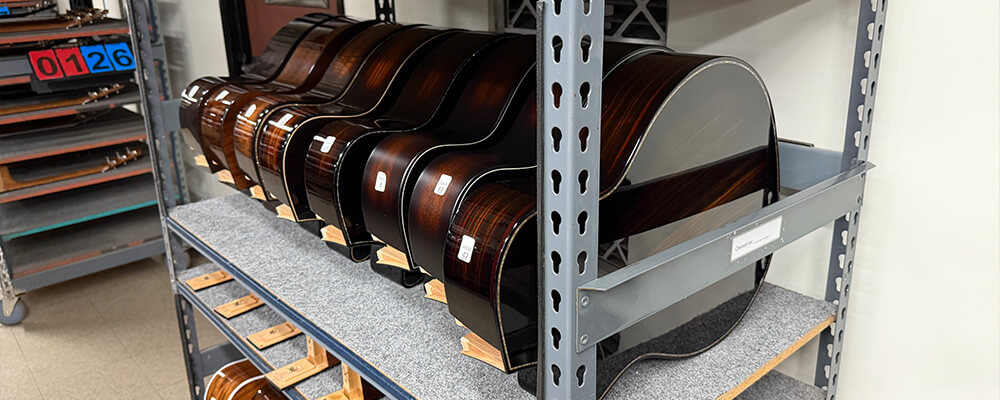
We saw guitar bodies in their nascent state — glued and clamped, held in jigs while the tonewoods find their permanent configuration. We also saw them in their most refined form: lacquered, fretted and strung, hanging on racks ready for final setup and inspection.
The finishing department is where a Taylor guitar’s character becomes visible. High-gloss lacquer is applied in careful coats, each one cured before the next is laid down. On the custom and premium models, nitrocellulose lacquer is applied with even greater attention. The result is the mirror-like sheen on backs and sides that makes a finished Taylor Custom feel like a fine piece of jewellery.
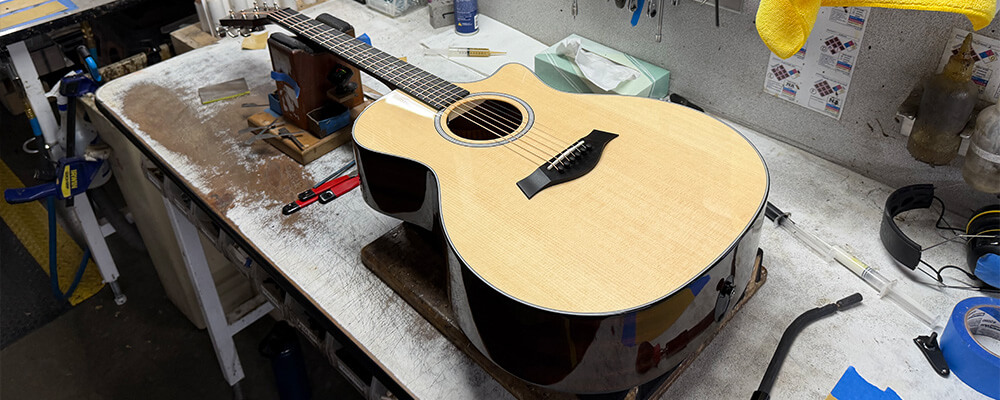
The bracing station was another highlight. Taylor’s proprietary V-Class bracing — Andy Powers’ most iconic contribution to acoustic guitar engineering since joining the company — is applied by hand, with each brace glued and shaped to precise tolerances. The Next Generation models now feature the updated Scalloped V-Class bracing profile, which, according to Taylor, opens the low end further and adds bloom and resonance while preserving the pitch accuracy and sustain that made V-Class famous in the first place.
The Finer Details & the Art of the Rosette
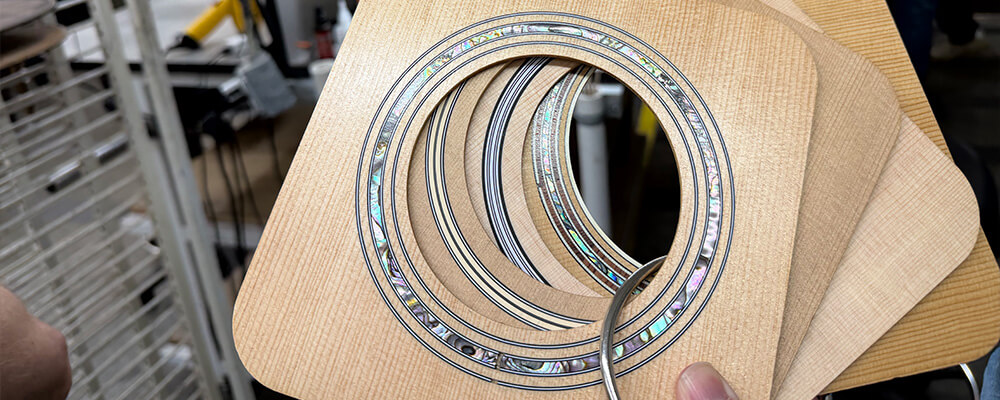
One of the highlights of the visit was getting up close with the decorative elements that distinguish Taylor’s higher-end instruments, and none was more striking than the paua abalone rosettes used across the Gold Label and Custom collections. We were shown sample rosette rings featuring shimmering, iridescent paua shell inlay (a material that catches the light differently with every movement of the guitar).
These rosettes are assembled with painstaking care. Each piece of abalone is individually placed and trimmed, surrounded by fine purfling lines in contrasting materials. On the Gold Label 914e and 917e (the flagship models of the current Gold Label Collection), this level of ornamentation extends across the top edge, fretboard and headstock, creating what Taylor describes as “ultra-premium visual refinements” that match the tonal ambition of those instruments.
Taylor’s Biggest Launch in Years: The Gold Label & Next Generation Explained
“It’s like players are stepping into a different musical skin with our Gold Label guitars. Songwriters, bluegrass players, Americana players — all kinds of different players saying: Wow, I love this sound.”
— Andy Powers, Chief Guitar Designer & CEO, Taylor Guitars
The timing of our factory visit couldn’t have been more fortuitous. At NAMM 2026, Taylor unveiled what the company is calling one of its most ambitious expansions to date — a dual announcement that positions the brand at two distinct points on the acoustic guitar spectrum simultaneously.
The Taylor Gold Label Collection: Heritage Sound, Modern Engineering
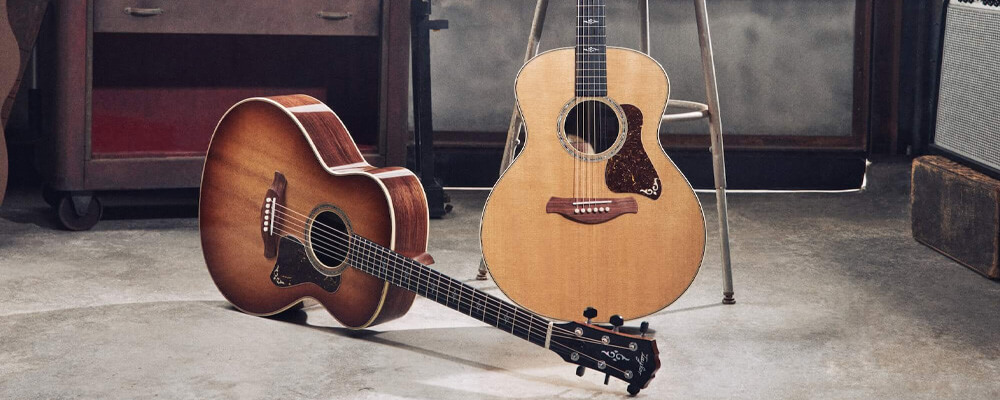
Introduced in 2025 and dramatically expanded at NAMM 2026, the Gold Label Collection represents Taylor’s most deliberate step towards the traditional acoustic guitar character. The collection is built around non-cutaway body shapes, torrefied Sitka spruce tops, and the innovative Fanned V-Class bracing.
The 2026 expansion adds a family of deeper-bodied square-shoulder dreadnoughts to the collection. Three tonewood pairings define the core range: the Gold Label 510e (mahogany and torrefied Sitka spruce), the Gold Label 710e (Indian rosewood and torrefied Sitka spruce), and the flagship Gold Label 810e (Honduran rosewood and torrefied Sitka spruce). Each delivers what Taylor describes as “pronounced warmth and projection”, or rather, the kind of sound that fills a room without amplification.
At the apex of the Gold Label range sit two new 900 Series instruments: the Super Auditorium Gold Label 914e and the Grand Pacific Gold Label 917e. Both pair Honduran rosewood with Adirondack spruce and feature the exquisite paua shell trim across the top, fretboard and headstock that we saw in person at the factory. Available in natural or golden-brown sunburst, these are statement instruments in every sense.
The Big Features:
Torrefied Sitka Spruce
Heat-treated to replicate decades of natural ageing. This results in the open, responsive tone of a vintage top from day one.
Fanned V-Class Bracing
Gold Label’s signature bracing adapts V-Class principles to achieve a heritage-style tonal character. The warm, full, and harmonically rich tones reminiscent of your favourite heirloom instruments.
Action Control Neck
Taylor’s long-tenon bolt-on joint allows players to adjust their action in seconds — no string removal, no tech required.
The Taylor Next Generation: The Modern Flagship, Reimagined
“As guitar makers, we see the ever-wider variety of players and styles. We want to offer the industry’s widest spectrum of acoustic tonal possibilities — from cutting-edge modern performance to time-honoured traditional character.”
— Andy Powers, Taylor Guitars
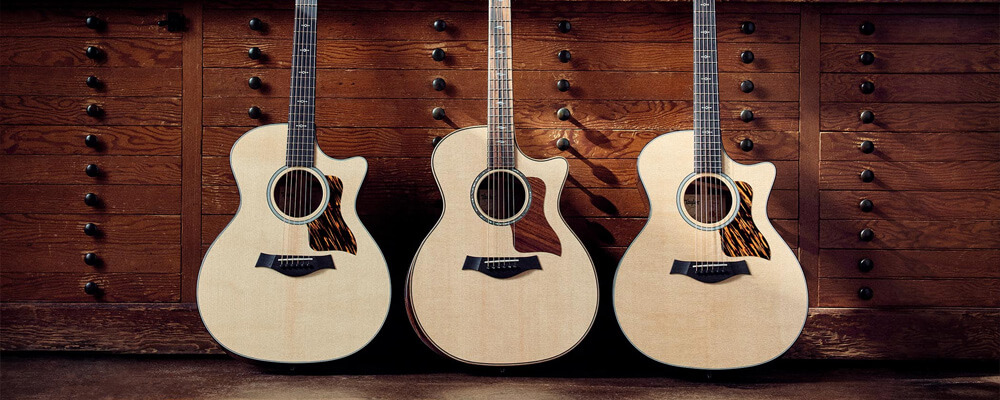
While Gold Label looks to the past for inspiration, the Next Generation series sees Taylor looking to the future. Launched across the 300, 400 and 800 Series Grand Auditorium models, the Next Generation update is defined by what Taylor calls the “ABC Framework”: three massive feature upgrades that work together to transform the playing and listening experience.
A — Action Control Neck: The long-tenon neck joint that debuted on Gold Label models is also found in the Next Generation lineup. This joint enhances warmth and sustain at the neck-body junction, and allows players to adjust string height without removing strings. A genuinely revolutionary feature for gigging musicians!
B — Scalloped V-Class Bracing: The updated bracing profile deepens Taylor’s signature low-end response, adds bloom to open chords, and enhances overall resonance without sacrificing the pitch accuracy and sustain that made V-Class bracing a game-changer.
C — Claria Electronics: Perhaps the most talked-about element of the Next Generation launch, the new Claria pickup system was developed with direct input from performing artists and live sound engineers. A reimagined undersaddle piezo pairs with a new proprietary preamp and three soundhole-mounted controls (Volume, Mid-Contour and Tone), giving players an unprecedented degree of tonal sculpting on stage or in the studio.
Together, the Gold Label Collection and the Next Generation Grand Auditoriums represent two compelling answers to the same fundamental question: what should a great acoustic guitar sound like?
Andy Powers Hand-Selects Four Wood Sets for Swee Lee
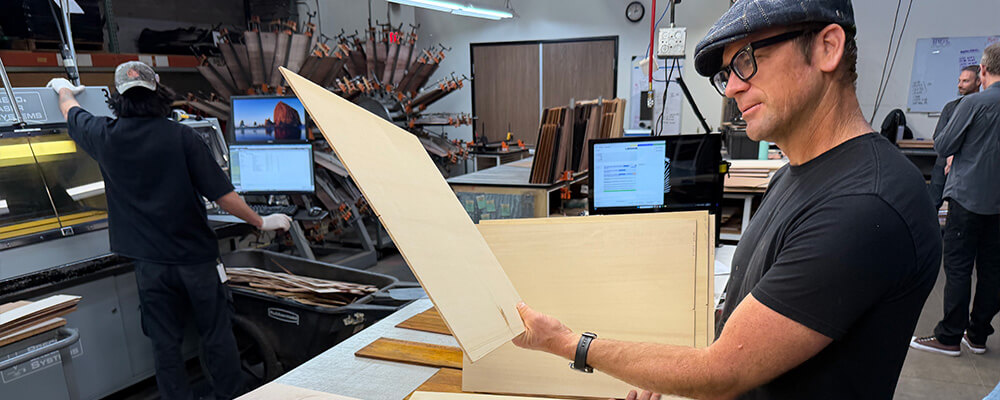
If there was a single moment that defined the visit, it was this. Deep in the tonewood selection area — surrounded by laid-out tops, backs and sides in every grade and species imaginable — Andy Powers took the time to personally evaluate and hand-pick four premium wood sets specifically for Swee Lee. Four sets of tone, grain, figure and character, chosen by the man who designs Taylor’s most ambitious guitars.
Watching Andy work through a selection of spruce tops is a masterclass in how a truly experienced luthier perceives wood. He’ll tap a top and listen — the tap tone reveals stiffness, resonance, and responsiveness before a single note has ever been played on the finished guitar. He’ll hold it to the light and read the grain: the number of lines per inch, the evenness of run-out, the presence or absence of bear claw figuring. He’ll run his hand across the surface and feel the texture that will eventually sit beneath a player’s strumming arm.
Each of the four sets he chose for us represents the top tier of what Taylor’s inventory had to offer that day. These are not catalogue-grade woods. They are the kind of pieces that get set aside for the instruments that need to be extraordinary.
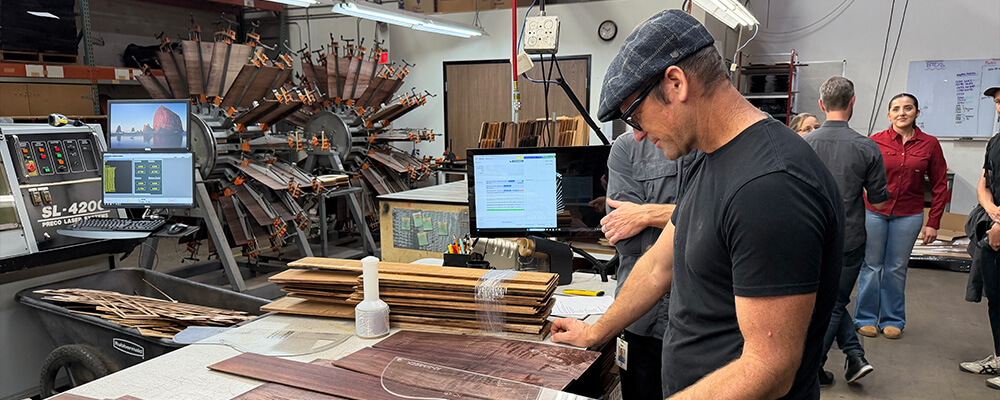
The four guitars being built from these sets are genuinely one-of-a-kind. Because Andy chose the wood in person, each instrument carries a provenance that goes beyond the typical custom guitar programme. This is the Taylor CEO personally investing his eye and judgment into your instrument. That is an extraordinary thing, and we don’t use that word lightly.
As of writing, one of the four guitars has already been claimed. If you’re interested in one of the remaining three, we encourage you to contact the Swee Lee team as soon as possible. Guitars at this level, chosen this way, don’t come around twice.
Custom guitar programmes are not unusual. What is unusual is having a company’s chief designer and CEO personally select the wood for your instrument. Andy Powers didn’t delegate this to a wood technician or a custom shop coordinator. He stood at the sorting table himself, evaluated each candidate piece, and chose the four sets he believed were worthy of the Swee Lee custom orders.
That process matters because tonewood selection is arguably the single most consequential decision in building a great acoustic guitar. Two instruments built to identical specifications — same body, same bracing, same setup — can sound dramatically different based on the quality and character of the wood used. The grain pattern, stiffness, density, moisture content and tap tone of each piece determine what kind of voice a guitar will have for its entire life. When the person making that decision is the man who redesigned Taylor’s entire acoustic engineering philosophy with V-Class bracing, you are starting from an extraordinary place.
Shop Taylor Guitars at Swee Lee
The guitars are expected to be completed in the coming months. If you’d like to secure one or perhaps discuss a custom build of your dream guitar, we invite you to get in touch with our team today.
Read more: Powers Electric Guitars: A New Era in Electric Instruments