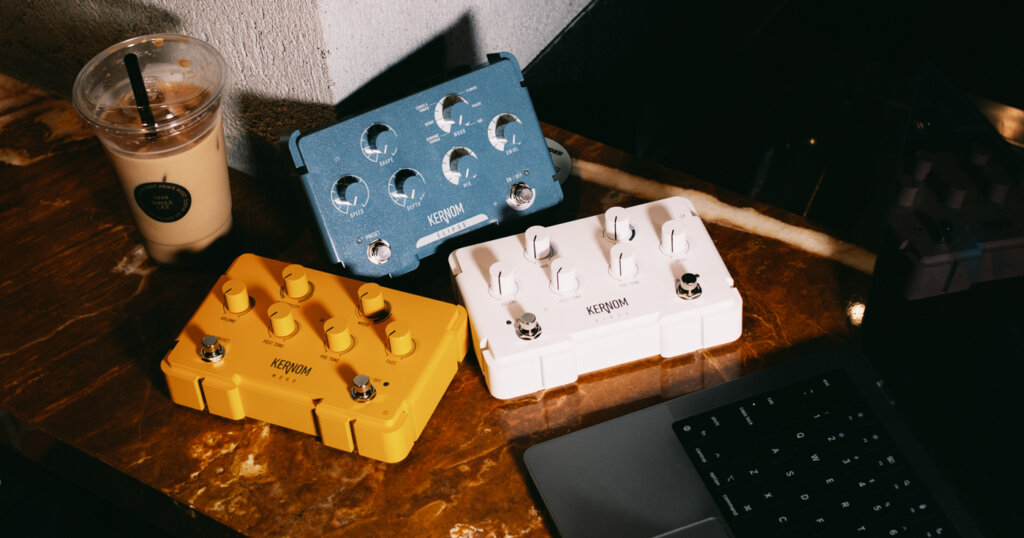
For the modern guitarist, the struggle is eternal: the search for the “perfect” tone often leads to a pedalboard that weighs more than the amp it’s plugged into. We’ve all been there—stacking three different overdrives to get the right gain stages or carrying a dedicated fuzz just for one specific solo. But what if you could condense those dozens of circuits into a single, high-end housing without sacrificing the soul of analogue gear?
Shop the Kernom Collection at Swee Lee
Enter Kernom. Since hitting the scene, this French brand has been disrupting the industry with a bold claim: you don’t need a digital modeller to have total flexibility. In this review, we are diving deep into the Kernom Ridge Overdrive, the Kernom Moho Fuzz, and the Kernom Elipse Modulation to see if these “Augmented Analog” powerhouses truly are the last effects pedals you’ll ever need to buy.
The Genesis of Kernom: Breaking the Analogue vs Digital Divide
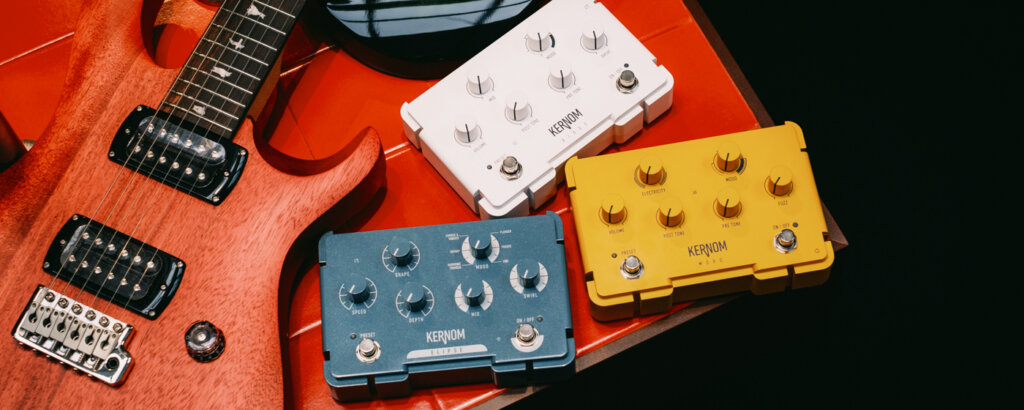
Founded in 2020 by a duo of passionate musicians and engineers, Kernom was born out of a specific frustration. For decades, guitarists had to choose between two worlds. On one hand, you had traditional analogue gear: responsive, warm, and harmonically rich, but physically limited to one or two “sounds.” On the other hand, you have digital modelling: incredibly flexible and preset-ready, but often criticised for being an “approximation” of the real thing.
Kernom refused to accept this compromise. They spent years researching how to keep the nonlinear behaviour of real diodes and transistors while introducing the control of a digital system. This led to the birth of their patented Analog Morphing Core®.
The brand’s vision is simple: music is a journey, and your tone should be, too. By moving away from fixed “modes” and embracing a continuous spectrum of sound, Kernom provides high-end guitar pedals designed for players who refuse to be boxed in by presets. Whether you are a studio pro or a gigging musician, the goal is the same—infinite tonal exploration.
The Power of Augmented Analogue: Understanding the Technology
The secret sauce behind every Kernom pedal is Augmented Analog technology. But what does that actually mean? To understand why these might be the best versatile overdrive pedal 2026 has to offer, we have to look under the hood at the Analog Morphing Core.
Analogue Components, Digital Brains
Unlike a digital “profile” or “model,” Kernom pedals use real semiconductor devices to generate their clipping and saturation. The signal stays in the analogue domain where it matters most—the nonlinear stages where grit and harmonics are born.
However, Kernom’s engineers discovered that by digitally controlling the biasing conditions of these components, they could change the way the circuit behaves in real-time. By adjusting the operating point of the diodes, the pedal can shift from the soft-clipping of a transparent overdrive to the hard-clipping of a modern distortion without ever switching to a different physical circuit.
Linear vs. Nonlinear Processing
Kernom makes a smart distinction in their electronic architecture. They keep the “character-defining” stages (clipping, saturation, compression) fully analogue. Meanwhile, they use high-quality digital conversion for linear tasks like frequency filtering and preset management. This allows for an analogue pedal with 128 presets—something previously thought impossible without massive relay-switching systems.
The MOOD Knob: The Most Expressive Control in Guitar Effects
If the Analog Morphing Core is the engine, the MOOD knob is the steering wheel. Instead of a 3-way toggle switch that jumps between pedal types, the MOOD knob is a continuous control.
As you turn it, the internal architecture of the pedal evolves. It’s not just an EQ shift; it is a fundamental transformation of the circuit’s behaviour. This allows for “hybrid” sounds that don’t exist in the pedal-verse.
Kernom Ridge Overdrive: The Overdrive on Overdrive
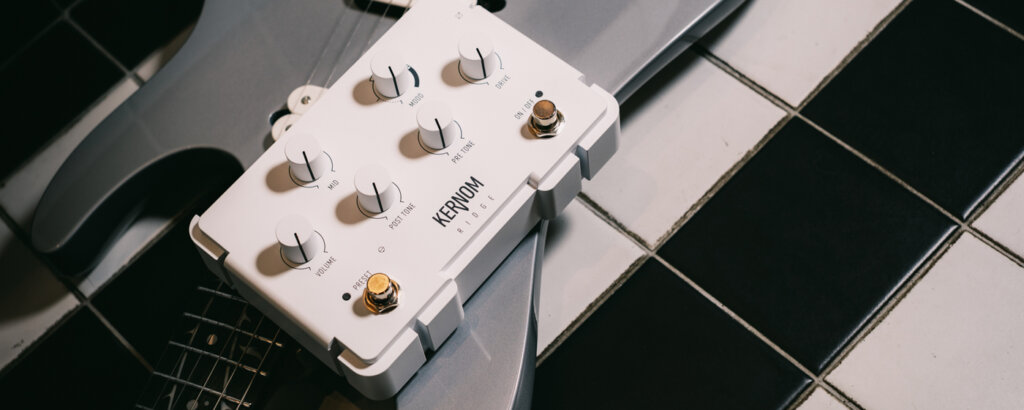
The Kernom Ridge Overdrive is arguably the most recognisable pedal of the lineup. This stompbox aims to replace every drive pedal on your board by offering a seamless spectrum from a clean boost to a high-gain monster. It is designed to be the only drive pedal you need, capable of mimicking legendary tones while allowing you to find the sounds between them.
- Ultimate Tonal Versatility: The MOOD knob allows you to morph between five distinct “worlds,” ranging from ultra-clean boosts to aggressive, borderline-fuzz distortion. This means you can dial in a Klon-style transparency and then sweep into a thick, saturated lead tone with a single turn.
- Precision EQ Shaping: The Ridge features a 3-band EQ section that allows you to sculpt your signal both before and after the clipping stage. This level of control ensures your guitar always sits perfectly in the mix, whether you need more “Pre-Tone” bite or “Post-Tone” warmth.
- Performance-Ready Control: With the ability to save up to 128 presets via MIDI and an expression pedal input for real-time morphing, the Ridge is built for the stage. You can transition from a subtle rhythm crunch to a soaring solo gain level without ever taking your hands off the guitar.
Kernom Moho Fuzz: The Fuzz Workstation
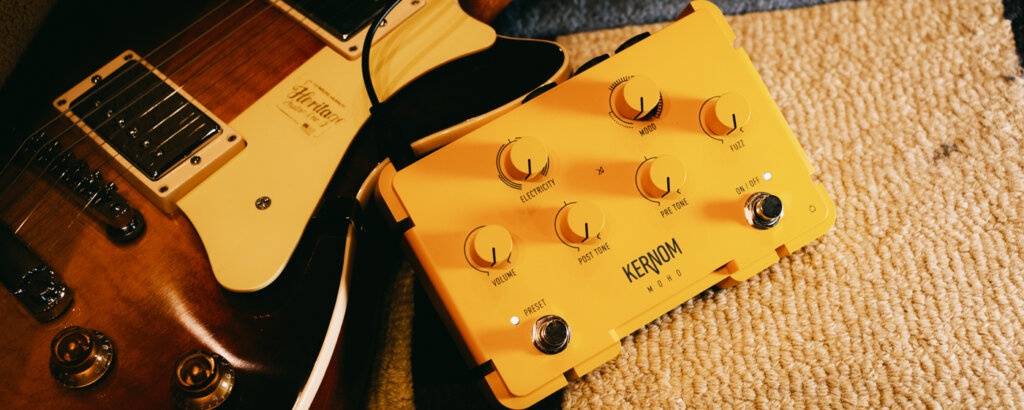
Fuzz is notoriously picky, often requiring specific placement in your signal chain and reacting wildly to temperature or guitar volume. The Kernom Moho Fuzz tames this chaos while expanding the sonic possibilities. In a Kernom Moho vs Big Muff comparison, the Moho wins on versatility every time, offering everything from “Velcro” gated fuzz to the massive wall of sound associated with 90s alternative rock.
- A Journey Through Fuzz History: The MOOD knob on the Moho takes you through five “Fuzz Worlds,” covering vintage 60s face-style tones, 70s sustain, and modern glitchy textures. It effectively puts a century of fuzz evolution into a single, high-grade aluminium casing.
- The Electricity Knob: This unique control introduces a built-in analogue octaver and ring modulator that can be blended into your fuzz signal. You can create thick, sub-heavy riffs with the octave down or piercing, psychedelic leads with the octave up.
- Modern Reliability: Unlike finicky vintage fuzz circuits, the Moho provides consistent, “Augmented Analog” performance that won’t change based on the weather or your power supply. It provides the unpredictability of a ring modulator with the stability of a precision-engineered workstation.
Kernom Elipse Modulation: The Modulation Playground
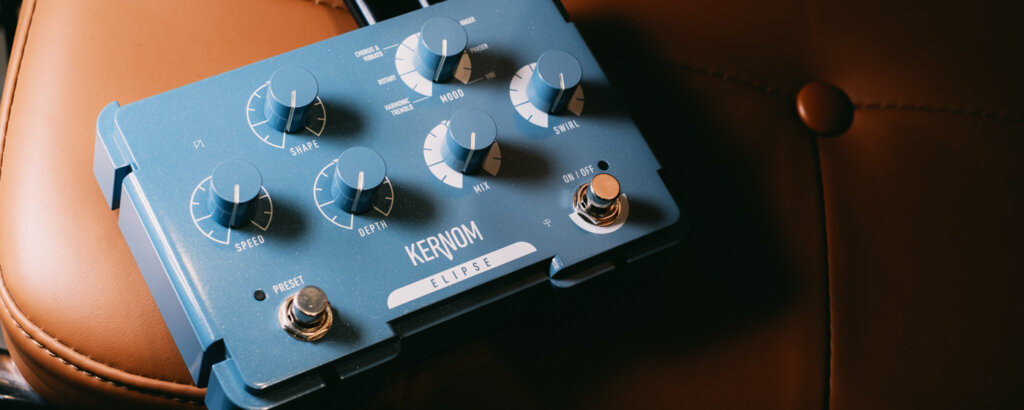
Modulation is often the hardest category to “get right” on a pedalboard because we usually want a bit of everything—a little chorus, a dash of phaser, and maybe some tremolo for the bridge. The Kernom Elipse Modulation solves the “too many pedals” problem by housing all iconic modulation effects in one box, powered by the same morphing technology found in its siblings.
- Seamless Effect Morphing: The Elipse allows you to transition smoothly between chorus, flanger, phaser, tremolo, and rotary speaker effects. This continuous control lets you stop anywhere in between to discover hybrid modulation textures that traditional pedals simply cannot produce.
- The Secret SWIRL Knob: This control adds a secondary layer of movement, introducing a slow-moving phaser or even an analogue drive circuit for added grit. It transforms standard modulation into a 3D, immersive experience that breathes life into your clean and dirty tones alike.
- Studio and Live Integration: With full MIDI Clock and Tap Tempo support, the Elipse stays perfectly in sync with your DAW or your drummer. The Kernom Elipse modulation review consensus is clear: it’s a professional-grade tool for those who demand precision and creativity in one package.
Integrating Kernom Into Your Rig: MIDI and Expression
One of the biggest selling points for the professional musician is the Kernom Ridge MIDI setup guide (which applies to the Moho and Elipse as well). While these pedals look like standard stompboxes, they are fully MIDI-compatible.
128 Presets at Your Feet
Most analogue pedals give you one sound at a time. Kernom gives you 128. By using a MIDI controller, you can instantly recall any setting you’ve created. This is a game-changer for session players who need to jump between a “Tube Screamer” mid-boost and a “Klon” transparent drive mid-song.
Guitar Pedals with Expression Pedal Morphing
The expression pedal input isn’t just for volume; it’s for morphing. You can assign the expression pedal to the MOOD knob (or any combination of knobs) and physically sweep between two different presets. Imagine starting a riff with a subtle 60s fuzz and gradually leaning into the pedal to morph it into a chaotic ring-modulated synth sound. It’s a level of expression that traditional gear can’t match.
Why Choose Kernom?
TLDR? Here is why they are becoming a staple on professional pedalboards worldwide:
| Feature | The Kernom Advantage |
| Technology | Patented Analogue Morphing Core® (Real Analogue, Digital Control) |
| Versatility | One pedal replaces 10+ legendary circuits |
| Control | MIDI, Expression Morphing, and 128 Presets |
| Build Quality | 5mm thick aluminium casing, built for the road |
The Kernom Ridge, Moho, and Elipse represent a new paradigm in effects pedals. By asking how analogue components can be made flexible rather than how digital code can sound analogue, Kernom has created something truly unique. These aren’t just pedals; they are instruments of analogue exploration.
Shop the Kernom Collection at Swee Lee
If you are tired of the constant “buy and sell” cycle of the pedal market, investing in a Kernom pedal (or three) might be the smartest move you make this year. Their pedals offer the warmth of the past with the control of the future!
Read more: Guitar Pedals for Beginners